Amazon Leo: More Launch Contracts—What Reaches the Customer?
Amazon announced on 10 September 2026 that it was adding six Ariane 6 launch contracts, expanding its Arianespace commitment from 18 to 24 launches. That is a useful fact about contracted capacity. It is not evidence that those six additional missions have already flown, or a measure of subscriber revenue.
The announcement is a starting point for a research notebook. To understand the business implications, separate four milestones that are often compressed into a single growth headline: booked, deployed, service ready, and paid usage.
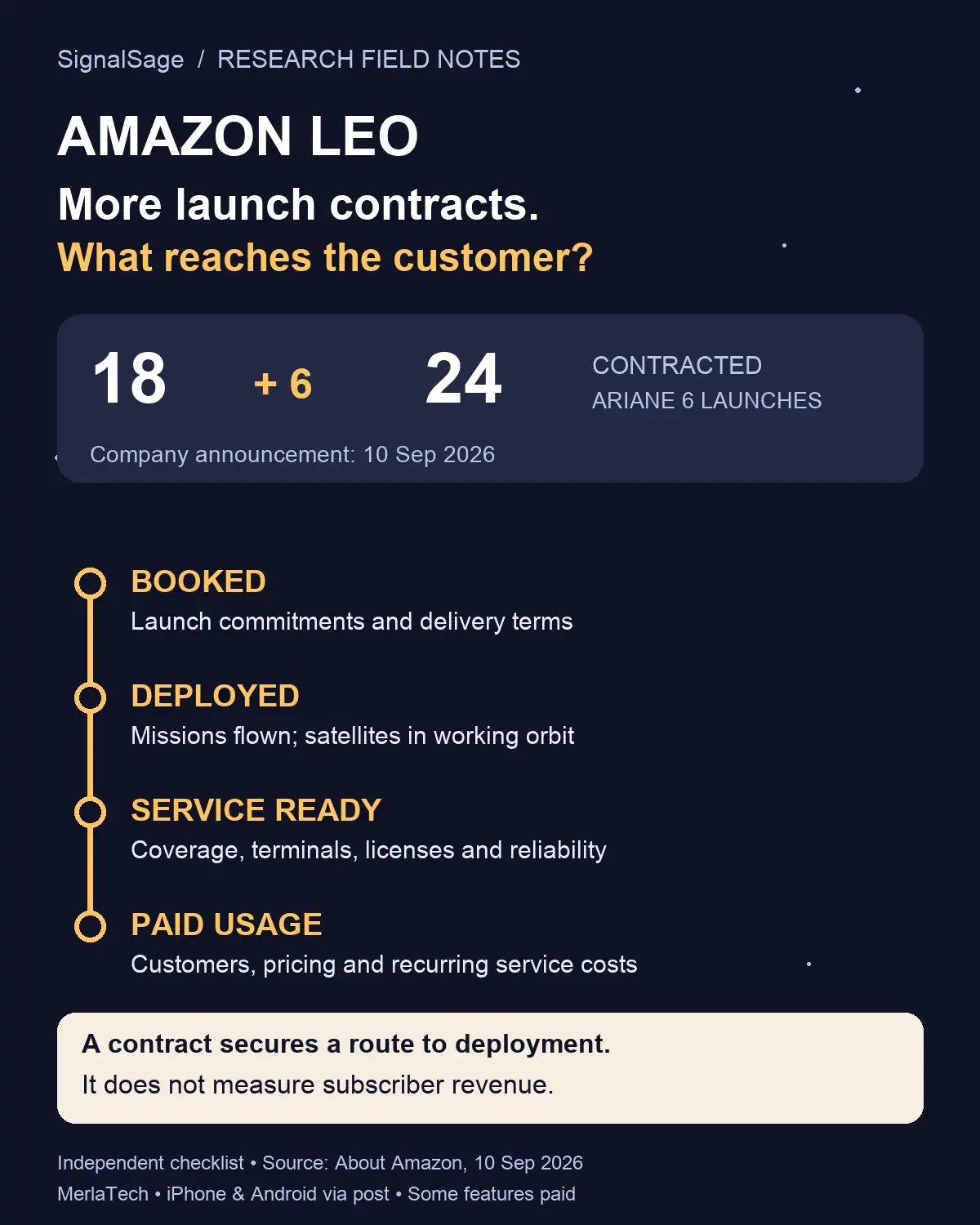
1. Booked: a commitment with conditions
A signed launch commitment can secure access to a scarce operational resource. The next questions concern execution: what delivery windows apply, what flexibility exists, and what dependencies could change the schedule? A headline contract count does not disclose all payment terms, cancellation provisions or the allocation of risk between counterparties.
Record what the source actually says in one column. Put the unanswered questions in a second column. This prevents an analyst from silently turning a stated commitment into a guaranteed outcome.
2. Deployed: count the completed milestone
Launch capacity and working network capacity use different units. A booked mission is not a satellite successfully placed in orbit; an orbital deployment is not necessarily the same as a satellite completing commissioning. Match every count to its definition and date.
Useful follow-up evidence would identify completed missions, payload deployment and commissioning status. Do not combine a launch-contract total with a satellite total as if they measured the same thing. Nor should an older constellation figure be presented as the latest figure merely because it appears beside a new announcement.
3. Service ready: connect infrastructure to a usable product
A customer needs an available service, compatible equipment and a reliable connection in a particular place. Independent research questions include coverage, terminal availability, licensing, installation, reliability and support. The relevant test is the actual service offered under stated conditions, not an isolated technical demonstration.
A practical notebook can identify the customer group and geography first, then ask what evidence supports readiness for that use case. Different requirements can make a broad statement such as “available” too vague to support a business comparison.
4. Paid usage: distinguish demand from economics
Interest, trials, customer contracts and recognized revenue are separate observations. Ask which stage a reported customer relationship represents. Then compare revenue with the costs needed to deliver it: equipment, network operations, support and ongoing investment.
These are questions to investigate, not claims about undisclosed Amazon Leo margins. A launch commitment alone cannot answer them, and a technology milestone cannot supply a stock valuation by itself.
A small research exercise
Suppose a fictional project signs ten launch contracts, completes two missions and begins a limited service trial. It would be inaccurate to label all ten contracts as completed launches or to describe trial participants as paying subscribers without further evidence. The numbers are invented only to illustrate the categories; they are not Amazon data.
Save a four-row checklist with these fields: milestone, unit, date, original source, verified result, and remaining uncertainty. Update the verified result when fresh evidence arrives. Keep forecasts in a separate column with their assumptions. This makes progress visible without converting expectations into facts.
Source: Amazon, 10 September 2026 announcement.
Independent education from the SignalSage / MerlaTech team; no affiliation with Amazon or Arianespace. Not investment advice or a return forecast.
SignalSage for iPhone and Android
English app; some features require in-app purchases/subscriptions.
iPhone / App Store — Stock Analysis: AI Buy Sell
Android / Google Play — Stock Analysis: AI Signals


Comments
Post a Comment