Microsoft’s AI Sales Case: 20% Higher—Than What?
Microsoft’s AI sales case: 20% higher close rates—than what?
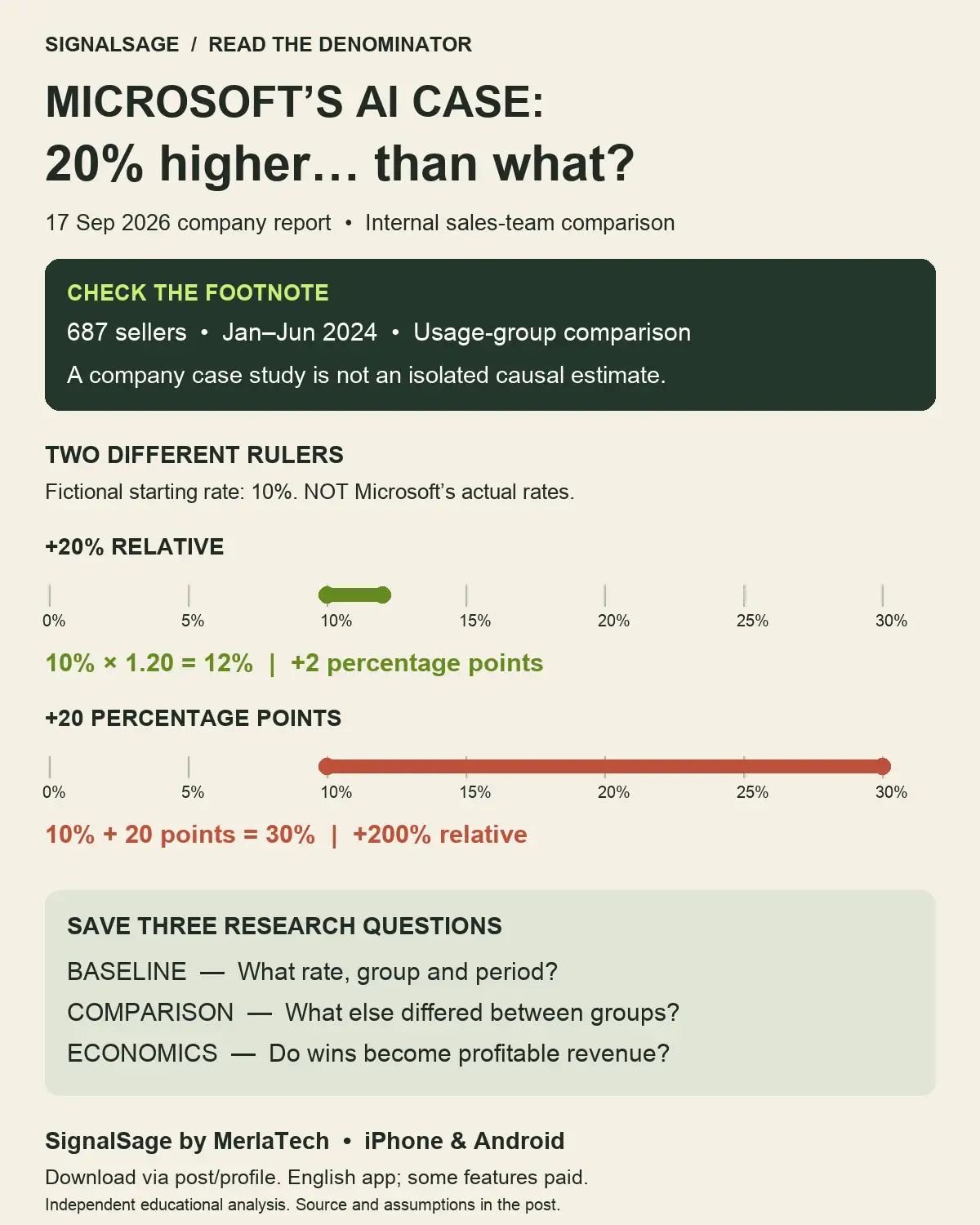
Microsoft’s 17 September 2026 post reports a sales-team comparison. Its footnote describes internal data on 687 sellers from January–June 2024, comparing regular Copilot users with low-usage sellers. This is a company-reported case, not today’s sales result or an isolated causal estimate of AI’s effect.
Our fictional ruler starts at a 10% close rate. A 20% relative increase reaches 12%: a gain of 2 percentage points. Adding 20 percentage points instead reaches 30%, a 200% relative increase. These are teaching examples, NOT Microsoft’s actual rates.
Before turning a productivity headline into a stock thesis, save three questions: What is the baseline, population and measurement period? What else differed between the groups? Did additional wins become recognized revenue with attractive margins after software, training and review costs?
A useful operational signal still needs a bridge to business economics. Source: https://blogs.microsoft.com/blog/2026/09/17/what-weve-learned-from-microsofts-own-ai-transformation/
SignalSage by MerlaTech. iPhone & Android: https://merlatech-stock-analysis.blogspot.com/p/download-signalsage-iphone-android.html
English app; some features require in-app purchases/subscriptions. Independent education, not investment advice.
A practical worksheet
Write the numerator and denominator before calculating change. For a close rate, record won deals and eligible opportunities under one definition. Excluding cancelled deals, changing the opportunity threshold or shifting the reporting period can change the ratio without improving the underlying selling process. Keep those choices visible.
Use matching cohorts. A frequent-user group may differ in experience, territory, customer mix, deal maturity or manager support. Those are questions for further evidence, not accusations that a reported result is false. A comparison can be informative while leaving the cause uncertain. Check sample selection, missing observations and whether the same result appears in later periods.
Then separate rate from scale. In a second fictional example, 100 comparable opportunities at a 10% close rate imply 10 wins; 100 at 12% imply 12 wins. But 50 opportunities at 12% imply only 6 wins. A higher rate alone does not guarantee more wins. Deal sizes, cancellations, implementation timing and recognition rules add further questions before estimating revenue. These hypothetical examples do not describe Microsoft performance.
Finally, look at total costs and persistence. Tool subscriptions, integration, security review, training and human quality control belong in a business case. Time saved can be redeployed rather than removed from payroll. A credible stock-research note records what is observed, what is inferred and what evidence could change the conclusion. It does not multiply a selected team result across an entire company without supporting data.
Official source: Microsoft, 17 September 2026.
Get SignalSage: iPhone / App Store | Android / Google Play. English app; some features require in-app purchases or subscriptions.


Comments
Post a Comment