Copilot Autopilot: Who Pays While the Agent Keeps Working?
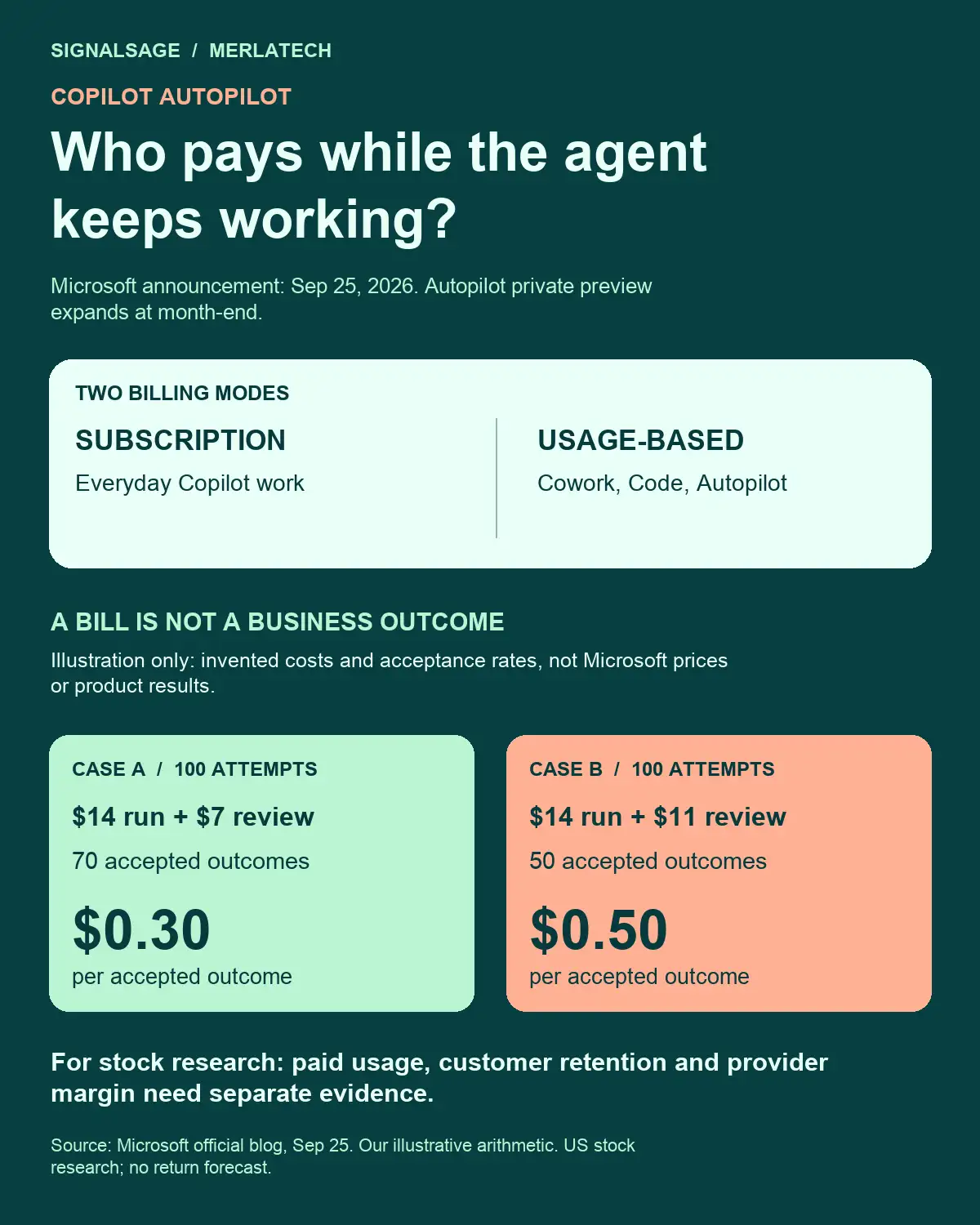
An agent that keeps working after you leave can also keep consuming resources. Microsoft’s September 25 Copilot announcement makes the billing question unusually concrete: everyday subscription work and long-running agent work have different spending models. Investors need to connect that architecture to customer value before jumping to a revenue conclusion.
Microsoft says Cowork, Code and Autopilot run on usage-based billing. Autopilot is cloud-hosted and persistent; its private preview is expanding at month-end. Home and Code are beginning their Frontier rollout in the coming weeks. These are announced rollout stages, not proof that every customer can already use every feature.
The useful unit is an accepted business outcome, rather than a task attempt. A supplier review, spreadsheet or internal tool might need rework, checking and approval. Counting every agent run as productive output hides those costs. Keep run cost, review cost and accepted output in separate columns.
Our graphic uses invented numbers to make that denominator visible. In Case A, 100 attempts cost $14 to run and $7 to review; 70 outputs are accepted. Total cost is $21, or $0.30 per accepted outcome. In Case B, the same 100 attempts still cost $14 to run, but review rises to $11 and only 50 outputs are accepted. Total cost becomes $25, or $0.50 per accepted outcome. Neither case describes Microsoft pricing, Copilot performance or a customer result.
The arithmetic changes the question from how many tasks ran to what usable work cost. A lower model price could help the numerator while more rework weakens the denominator. Conversely, higher spending can be worthwhile if a customer obtains more useful output. The acceptance standard should be written before measuring the result, and should match the actual business task.
For Microsoft stock research, customer economics and provider economics are connected but different. Greater metered usage can produce billings, yet serving that usage has costs. Sustained customer value may support renewal and expansion; a costly burst of experiments may not. Look for disclosed paid consumption, retention and margin evidence. Do not substitute an impressive capability demo or an invented workload for those financial facts.
Microsoft also announced tools for controlling and reviewing AI spending. Spending controls are a product capability. They are not a measured claim about savings, customer profitability or Microsoft revenue. This note offers a research framework, not a prediction about earnings or the share price.
Official announcement (Sep 25, 2026): Microsoft: Home, Code and Autopilot.
SignalSage by MerlaTech: US stock research. English UI; some features require in-app purchase or subscription. Save and follow for research diagrams.
iPhone & Android downloads · iPhone / App Store · Android / Google Play


Comments
Post a Comment