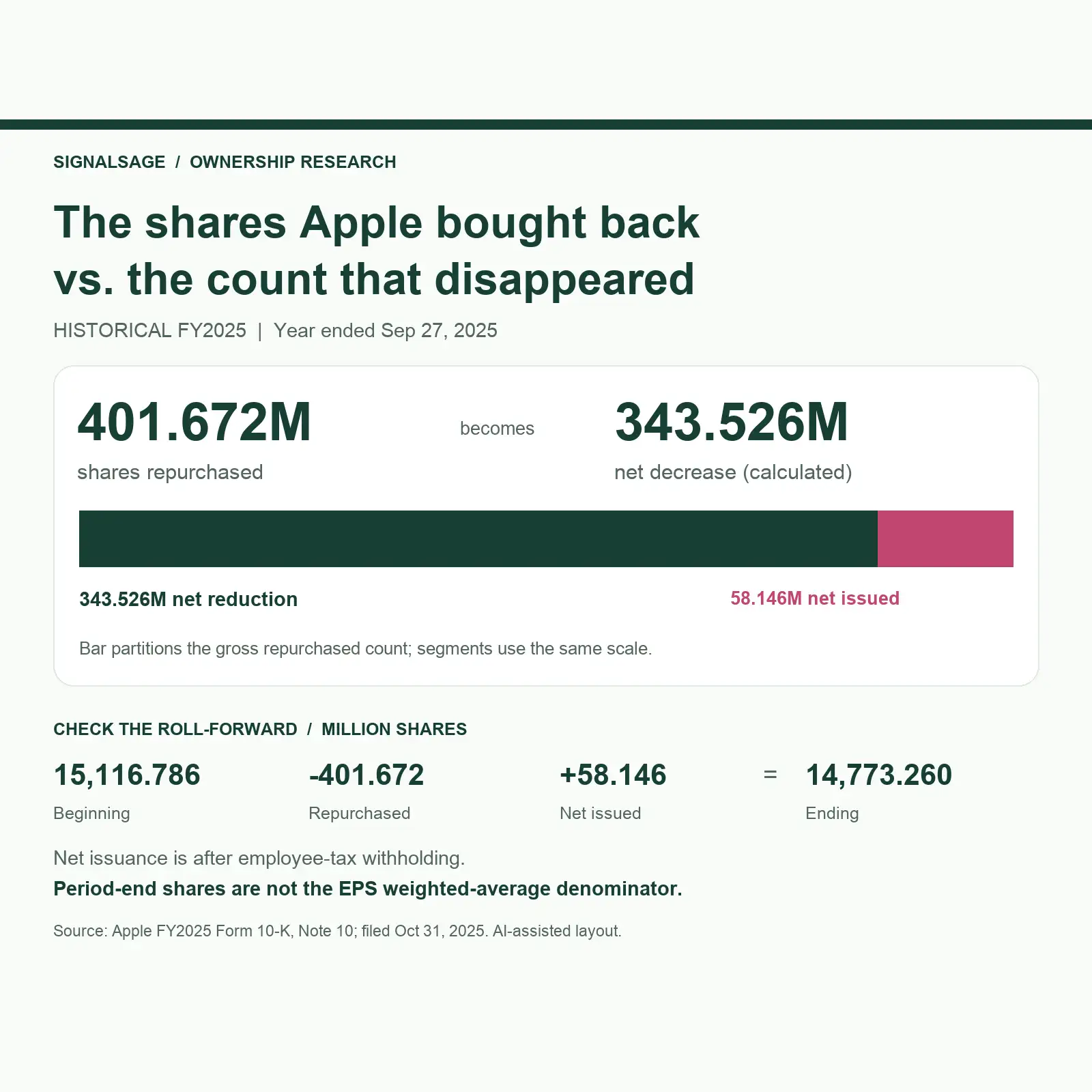
Apple repurchased 401.7M shares. Its share count fell by 343.5M.
A buyback headline tells you how many shares a company acquired. To study the ownership denominator, also reconcile the shares that entered circulation. Apple's FY2025 filing provides a clean historical example: gross repurchases exceeded the net decline in outstanding shares. That gap is useful evidence, rather than a verdict about whether the stock was cheap.
Historical evidence, with dates attached
This case covers the fiscal year ended September 27, 2025. Apple filed the Form 10-K on October 31, 2025. It is a historical research exercise, not a new FY2026 announcement. Note 10 presents its share roll-forward in thousands; the figures below convert that table to millions.
Reconcile the count
Beginning shares of 15,116.786 million, less 401.672 million repurchased, plus 58.146 million issued net of employee-tax withholding, equal 14,773.260 million ending shares. Our subtraction gives a net decrease of 343.526 million. The filing separately describes approximately 402 million shares repurchased for $89.3 billion. The rounded narrative and the more precise roll-forward describe the same historical program activity.
What the gap establishes
The issuance line explains the difference between gross repurchases and the net reduction in this roll-forward. Calling the entire gross count a reduction in outstanding shares would overstate that reduction. Conversely, the positive issuance line does not mean the share count rose: the combined result was still a decline. Keep gross flows and the final balance on separate lines.
Match the denominator to the question
A period-end balance is a snapshot. EPS uses a denominator that reflects a reporting period; the diluted calculation also considers dilutive awards. Apple reports its EPS calculation separately in Note 3. Use that table when checking EPS, rather than substituting the ending balance from Note 10. An ownership snapshot and an earnings calculation answer different questions.
A reusable research check
For your next filing, record the measurement period and unit first. Then reconcile beginning shares, repurchases, issuance and ending shares. Finally, identify which denominator your comparison actually needs. This sequence makes a capital-return headline easier to test without turning it into a price target. A smaller denominator alone cannot establish investment value; the economics of the cash spent still need examination.
Continue your research
Explore SignalSage by MerlaTech for US Stock Research / AI Stock Analysis. The app uses an English interface; some features require in-app purchases or subscriptions. Download options for iPhone and Android are linked below. This illustration is an independently prepared source-based explanation, not an app benchmark or a return forecast.
Disclosure
AI-assisted writing and layout; original diagram generated for this research case. Historical figures are attributed to Apple's SEC filing. Educational information, not personalized investment advice.
Sources: Apple FY2025 Form 10-K, Notes 10 and 3; SEC filing date and report period.


Comments
Post a Comment